Keynote Speaker
- AI & Synthetic Reality
- Narratives & Belief
- Judgement & Trust
Paula Slier helps audiences navigate one of the defining questions of our time: how do we know what to believe?
upcoming
speaking events
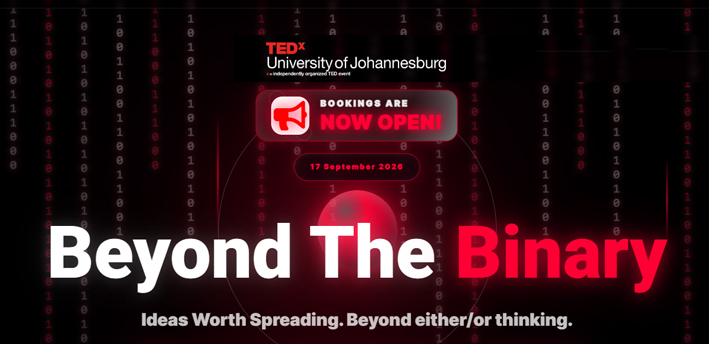
17 September
Beyond the Binary: Why the Most Dangerous Form of Information Warfare Is Emotional. TEDx University of Johannesbur
22 September at 9pm
talking at annual mini and junior city council, Johannesburg
17 NOVEMBER EVENING
MC at the 90th anniversary dinner of ORT-JET, JOHANNESBURG
RECENT EVENT
FROM BOOTS TO BOTS: WHAT WARZONES TAUGHT ME ABOUT SPEAKER CREDIBILITY IN AN AGE OF NOISE AND INFORMATION WARFARE
keynote topics
FROM THE WORLD’S FRONTLINES TO THE INFORMATION BATTLEFIELD
Every keynote begins with a story from the frontlines. Every audience leaves with a new way of understanding the world.
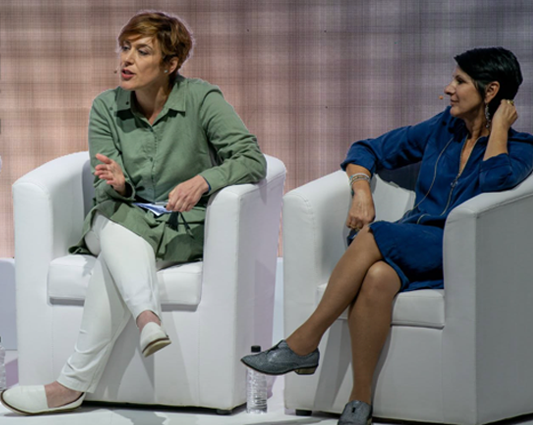
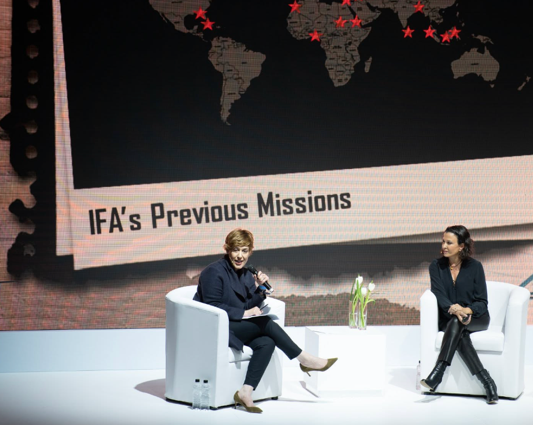
BEHIND THE FRONTLINE: THE WAR YOU DON’T SEE
Beyond the headlines are the human stories of conflict.
- Paula reveals the untold stories, ethical dilemmas and defining moments that rarely make the news, and what they teach us about humanity, leadership and courage.
FROM BOOTS ON THE GROUND TO BOTS ON THE SCREEN
How do you know what is true?
- In an age of artificial intelligence, digital media and competing narratives, distinguishing fact from influence has never been more difficult. Paula explores the hidden information battlefield that shapes what we believe, the decisions we make and the world we create.
THE BULLET I DIDN'T DODGE: HOW I LOST EVERYTHING AND FOUND MYSELF
What happens when the greatest threat isn’t the one you see coming?
- A deeply personal story of betrayal, loss and resilience that explores how life’s greatest setbacks can become the foundation for renewed purpose and lasting impact.
FEARLESS & FEMALE: BREAKING BARRIERS ON THE FRONTLINE
What does real courage look like when the odds are against you?
- Paula shares powerful lessons on courage, confidence and resilience from her experience as a woman reporting from some of the world’s toughest conflict zones.
- Brings frontline insight to audiences around the world.
- Shares the stage with heads of state, diplomats, military leaders, policymakers and global thought leaders.
- Moderates high-level conversations on modern conflict, geopolitics, information warfare and the future of truth.
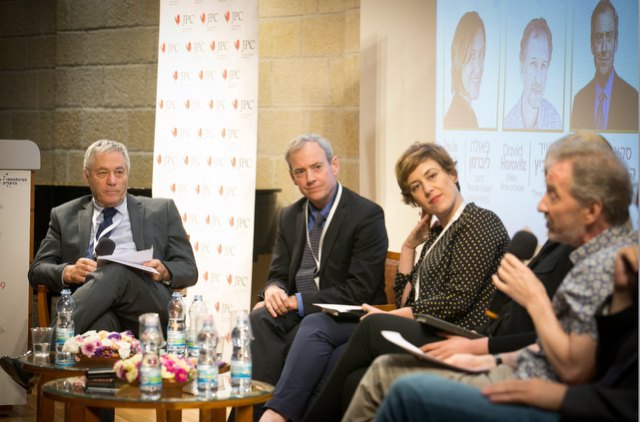
SEPTEMBER 2025
PSASA, JOHANNESBURG, SOUTH AFRICA
Hooked online: How teens get caught - and how to stay safe
Understanding how the media works and how to get it to pay attention to you.
A hands-on workshop that will get you free media publicity as a professional speaker.
AZAMARA CRUISE, South Africa, Madagascar, Reunion, Mauritius,, India, Sri Lanka, Singapore
DECEMBER 2025
Enrichment and Destination Speaker
- Behind the Frontline: The War You Don’t See
- From Trenches to TikTok: Reporting War in the Digital Age
- Fake News: How the Media Tricks, Tracks and Influences Us
- Truth Toolkit: How to Keep Your Mind Safe in a World of AI and Misinformation
- Women at War: On the Front Line and Online
- The Bullet I Didn’t Dodge: The War I Never Saw Coming
- Protecting the Next Generation: Keeping Children and Grandchildren Safe Online
DECEMBER 2025
LIMMUD FESTIVAL, Birmingham, UNITED KINGDOM
Hooked online: How teens get caught - and how to stay safe
International journalist Paula Slier shares her personal experience of betrayal to help teens recognise online traps. From romance scams to sexting blackmail, this session equips young people with the awareness to spot warning signs, protect themselves, and make safer choices. Above all, it shows them how to know when trust is being exploited.
Inside Hamas's propaganda machine
From doctored footage to emotional appeals, Hamas has built one of the most effective propaganda machines of our time. War correspondent Paula Slier unpacks how Hamas brands itself as victim and victor, weaponised October 7th into a media campaign, and why these narratives resonate globally.
22, 23 JANUARY 2026
UCT summer School
Cape Town, South Africa
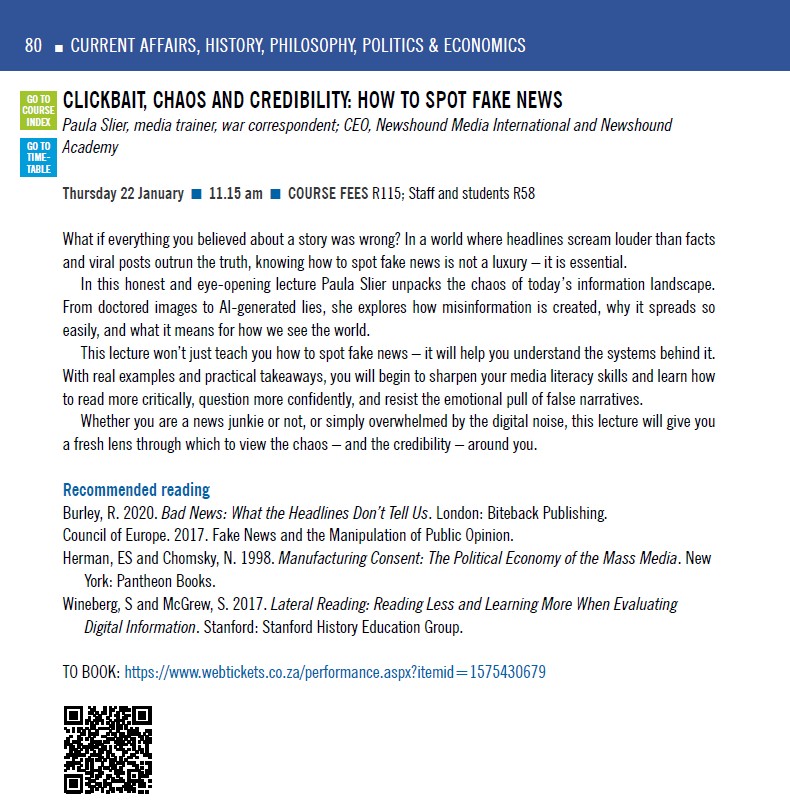
CLICKBAIT, CHAOS AND CREDIBILITY: HOW TO SPOT FAKE NEWS
What if everything you believed about a story was wrong? In a world where headlines scream louder than facts and viral posts outrun the truth, knowing how to spot fake news is not a luxury – it is essential.
SAND, SWEAT AND SATELLITE PHONES: REPORTING WAR IN THE 21ST CENTURY
What does it mean to risk your life for a story – and what happens when the cameras stop rolling?
27 JANUARY 2026
PROBUS, SANDTON, SOUTH AFRICA
BEHIND THE FRONTLINE: THE WAR YOU DON’T SEE
8 FEBRUARY 2026
SECOND INNINGS LIFELONG LEARNING & ENGAGEMENT COMMUNITY
MY THIRTY YEARS AS A WAR CORRESPONDENT IN THE MIDDLE EAST, NORTH AFRICA, RUSSIA AND INTERNATIONALLY
BEHIND THE FRONTLINE: THE WAR YOU DON’T SEE
16 FERUARY 2026
PRIVATE WOMEN’S GROUP
THE BULLET I DIDN’T DOGE: HOW I LOST EVERYTHING AND FOUND MYSELF
5 March 2026
PECHAKUCHA, JOHANNESBURG, SOUTH AFRICA
THE AGE OF TOO MUCH KNOWING
PechaKucha is a Japanese expression meaning “chit-chat” or “casual conversation.” It is a fast-paced presentation format established in Tokyo in 2003, in which exactly 20 slides are shown for 20 seconds each, creating a talk lasting 6 minutes and 40 seconds.
16 April 2026
PSASA SPEAKER FACTOR, JOHANNESBURG, SOUTH AFRICA
THE SILENCE OF WAR, THE SILENCE WITHIN
12 May 2026
ORT-JET, JOHANNESBURG, SOUTH AFRICA
HOW TO SPOT FAKE NEWS
In today’s fast-moving world, the real challenge is no longer accessing information - it’s knowing what to believe. Misinformation spreads faster than the truth and AI can create content that looks completely real. It’s getting harder (and riskier) to tell fact from fiction. Join award-winning journalist Paula Slier for an interactive session on spotting misinformation and understanding media bias. Learn practical tools to think critically and uncover the truth behind the headlines. You’ll walk away with tools to question what you see, verify what you read, and pause before you hit “share.” Because in today’s world, believing the wrong thing doesn’t just misinform - its spreads. This is not just another workshop. It’s a reality check.
21 May 2026
CHABAD OF GREENSTONE, JOHANNESBURG, SOUTH AFRICA
TRUTH IN A WORLD OF NOISE
BEIS MENACHEM, JOHANNESBURG, SOUTH AFRICA
CLICKAIT, CHAOS AND CLARITY
In a world flooded with headlines, algorithms, outrage and endless information, how do we know what is true anymore? Drawing on more than two decades reporting from global conflict zones, award-winning journalist Paula Slier explores how we can hold onto clarity, humanity and connection in an age of noise.
30 May 2026
STELLENBOSCH BUSINESS INSTITUTE, JOHANNESBURG, SOUTH AFRICA
THE BIAS OF FRAMING
7 July 2006
INTERNATIONAL WOMEN’S CLUB, JOHANNESBURG, SOUTH AFRICA
BEYOND THE BATTLEFIELD: THE UNTOLD STORIES OF WAR REPORTING
21 July 2026
UNIVERSITY OF THE THIRD AGE, JOHANNESBURG, SOUTH AFRICA
FROM PHYSICAL WAR ZONES TO THE INFORMATION BATTLEFIELD: HOW TO KNOW WHAT’S TRUE
After more than 30 years reporting from some of the world’s most dangerous conflict zones, award-winning South African journalist Paula Slier has come to an unexpected conclusion: the most important battlefield today isn’t always the one with bombs and bullets - it’s the one on the device in your hand, competing for your attention, your beliefs and your decisions.
Artificial intelligence, deepfakes, social media and misinformation have transformed the way we receive, interpret and share information.
So how do we know what’s true? Why do intelligent people believe false things?
Drawing on extraordinary stories from the front lines of conflict, including her impressions of the current Iran and wider Middle East situation,
Paula takes audiences on a fascinating journey from physical war zones to today’s information battlefield.
Along the way, she shares practical tools to help audiences think more critically, ask better questions and navigate an increasingly complex information landscape.
This is a thought-provoking, entertaining and highly practical talk that will change the questions you ask before you believe what you hear, read or watch - and perhaps the way you see the world.
24 July 2026
PSASA NATIONAL CONVENTION, UMHLANGA, SOUTH AFRICA
FROM BOOTS TO BOTS: WHAT WAR ZONES TAUGHT ME ABOUT SPEAKER CREDIBILITY IN AN AGE OF NOISE AND INFORMATION WARFARE
Taking the Stage Around the World
"Ensuring Safety Protocols for Journalists”
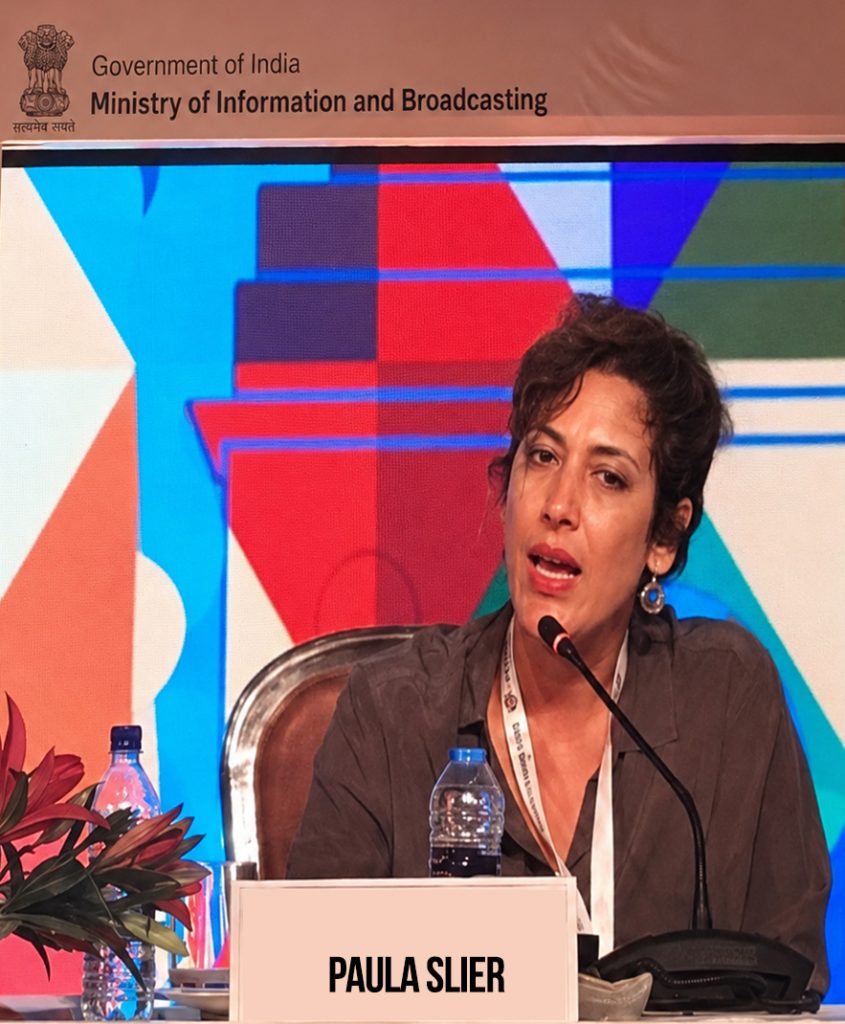
- Panelist in the UNESCO World Press Freedom Day conference in Accra, Ghana
"Telling Compelling Stories: Challenges and Opportunities”
- Addressed Asia Media Summit in New Delhi, India
“Reporting from the Middle East: Separating Fact from Fiction”
- Panelist in the Global Coalition 4 Israel Forum in Jerusalem, Israel
“The New Journalism Story: Where did the technology disappear?”
- Addressed DIGIT – Online Journalism Conference – in Herzliya, Israel
“Reporting on Peace and Conflict: Have the Rules Changed?”
- Addressed the Asia Media Summit in Qingdao, China
“Safety of Women Journalists”
- Addressed the Women with the Wave Forum of the Asia-Pacific Broadcasting Union in Istanbul, Turkey
"FEARLESS AND FEMALE ON THE FRONTLINE"
- Delivered a keynote to the MENA Media Forum in Cairo, Egypt
“CRITICAL MINDS FOR CRITICAL TIMES”
- Participated in the UNESCO World Press Freedom Day conference in Jakarta, Indonesia
"THRIVING IN THE NEW MEDIA ERA"
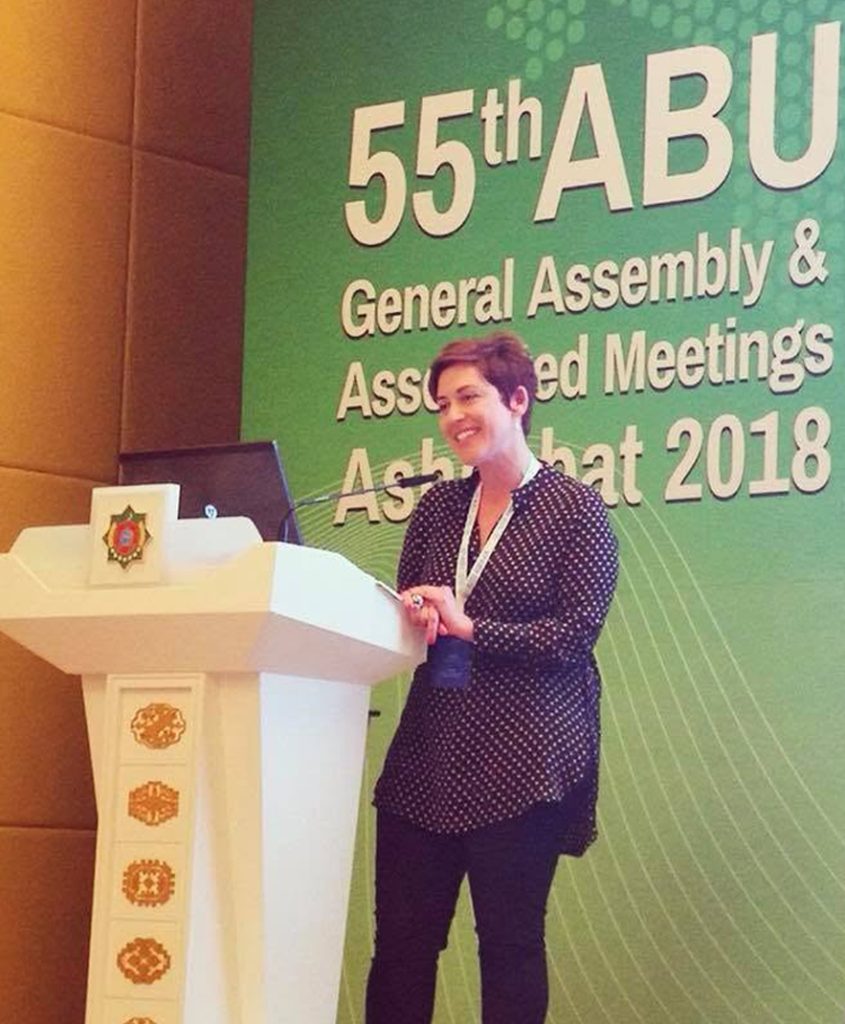
- Addressed the Women with the Wave Forum of the Asia-Pacific Broadcasting Union in Ashgabat, Turkmenistan
"Building Trust: Enriching Audience Experience"
- Addressed the Asia-Pacific Broadcasting Union Conference in Tokyo, Japan
“OSCE Safety of Journalists in Conflict Situations”
- Participated in various working sessions of the OSCE (Organisation for Security and Co-operation in Europe) for human rights and democracy dedicated to the work of journalists in conflict zones. Addressed conferences in Vienna, Warsaw and Vilnius
The question is no longer "Is this true?" The question is: "Why am I seeing this? Why now? What's missing?"
- paula slier
speaking testimonials
- "I'm receiving so many compliments about our fabulous speaker today l just have to pass it on. You really hit the spot with our members and so the compliments should go to you. Please keep in touch with us and come back when you are launching your book as we'd love to welcome you again."
DI LAVERY, INTERNATIONAL WOMEN’S CLUB OF SOUTH AFRICA
- "Once again many thanks for a brilliant presentation as always. Your knowledge of the complexities in Israel and the Middle East is extraordinary. But it is your incredible ability to engage with your audience and to make difficult issues accessible that is really impressive. The audience was riveted and I’ve had amazing feedback."
HAZEL COHEN, GREAT PARK COMMUNITY CENTRE, south africa
SANDY SMITH, SANDTON PROFESSIONAL BUSINESS FELLOWSHIP
- “You are the most amazing speaker. I have received such lovely remarks from our members who think you are an outstanding speaker. Somehow you managed to make us feel that we were a part of your story.”
Raksha Mahabeer, Brand & Marketing Strategist
- “Your talk has stayed with me, it was one of the most impactful ones from the entire convention. Thank you for challenging me around identity, authenticity and reputation.
- “I feel so thankful to you for the excellent presentations Paula. You were almost certainly rated as one of the best speakers at Summer School amongst a really excellent group.”
MELODIE WESSELS, UNIVERSITY OF CAPE TOWN SUMMER SCHOOL
- "Was a really great presentation. It is still being spoken about! Attagirl! Shelley Addis, University of the Third Age. You are brilliant - Madeleine Fane
- Great presentation and explanation. That's why your opinion page in the Jewish Report is the first article I read. Interesting times ahead - Johnny Schwartz
- Thank you Paula. Excellent and informative! - Adene Davis
- You gave a very informative talk - Idafay Mervisthank
- Excellent presentation - Charles Silbert
- Outstanding, thank you - Arnold Urson
- Great sense of humour and authenticity. I was sitting on the edge of my chair, as often laughing as fighting tears from being touched deeply - Maya Patel
- Please get those books out of you, we'd love to read so much more of your stories and apply the lessons to our lives - Virginia Solomons
GRECIA GABRIEL, SECOND INNINGS LIFELONG LEARNING & ENGAGEMENT COMMUNITY
- “Thank you so much for giving an absolutely amazing talk about your 30 year career as a War Correspondent in the Middle East and beyond. Everyone was absolutely SPELLBOUND and they just LOVED you. You put it all over so easily and without a single note. Everyone admires your courage. It was a SPECTACULAR morning and you are held in great esteem by us all.”
- "There is absolutely no doubt that you were the main attraction at all three South African conferences.”
SHERYL BENJAMIN, LIMMUD SHARK TANK, SOUTH AFRICA
- Your insights into media literacy, storytelling, and the responsibility that comes with communication were incredibly powerful and thought-provoking. I found the session deeply inspiring, especially as a young entrepreneur and creative navigating the importance of authentic storytelling in today’s world.